
Resetting a router fixes a surprising number of internet problems and is the standard step when you have forgotten the router’s admin password or want to start fresh. But it is important to know the difference between a quick reboot and a full factory reset — one keeps your settings, the other erases them.
Reboot vs. factory reset
- Reboot (power cycle): unplug the router for 30 seconds and plug it back in. This clears temporary glitches and slow connections. Your Wi-Fi name, password, and settings are kept. Try this first.
- Factory reset: restores the router to out-of-the-box defaults. Your Wi-Fi name (SSID), password, and all custom settings are erased. Use this only when a reboot is not enough.
When you should factory reset the router
You have forgotten the router’s admin login; the connection is unstable even after rebooting; you are selling or giving away the router; or a misconfiguration has broken your network and you want a clean start.
How to factory reset most routers
- With the router powered on, find the recessed Reset button on the back or bottom.
- Press and hold it with a paperclip for 10–30 seconds until the lights blink and the router restarts. (On some older models the “30-30-30” method is used: hold 30 seconds, keep holding through an unplug/replug for another 30+30.)
- Wait a few minutes for it to fully reboot.
Reconnect after a reset (important)
After a factory reset the router uses its default Wi-Fi name and password — usually printed on a label on the device. Connect to that, then open a browser and go to the router’s admin address (commonly 192.168.0.1 or 192.168.1.1) and sign in with the default admin credentials on the label to set up your network again.
Secure it while you are there
- Change the default admin password immediately.
- Set a strong Wi-Fi password and use WPA2/WPA3 encryption.
- Update the router firmware to patch security holes.
Only reset a router you own or manage. Find model-specific default addresses and credentials in the router brand list below.
If you do not know the username and password and do not access the router’s configuration utility, you will not be able to update any security settings.
If you do not remember the router’s username and password, or if your login credentials do not work, you will need to reset your router.
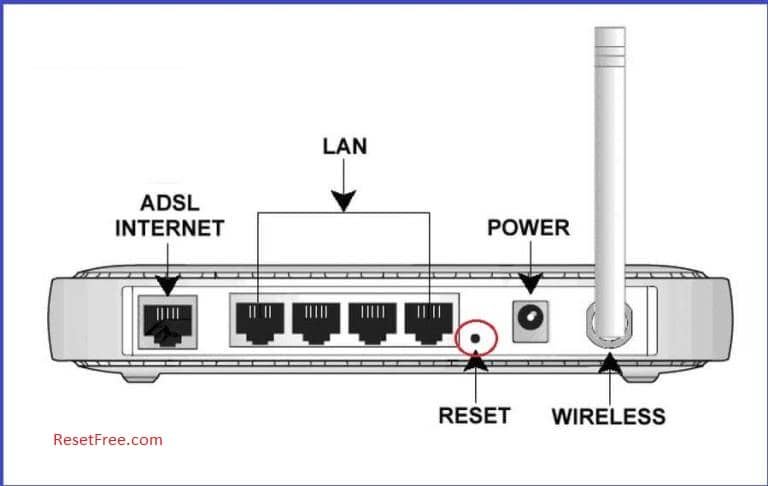
Rebooting the router and resetting the router are two different procedures. The reboot is a simple process and should be tried before you perform a reset.
If rebooting does not resolve the router issue, resetting the router is still available.
There are several reasons why you may want to reset your router to its factory settings.
Factory reset removes all personalized settings, including your username, password, WiFi network name, and security settings.
A factory reset is required when you are unable to recover your password. This is an important step when resolving certain network issues.
Top Router Brands
- 2Wire
- Actiontec
- AirLink
- Amped Wireless
- Apple
- Aruba
- ASUS
- Belkin
- Billion
- Cisco
- D-Link
- Huawei
- iBall
- Jio
- Kyocera
- Linksys
- Motorola
- NetComm
- Netgear
- Netis
- Sagemcom
- Sagem
- SMC
- Samsung
- Synology
- Sitecom
- Tenda
- Thomson
- TP-LINK
- TRENDnet
- TotoLink
- Xiaomi
- Zoom
- ZTE
- ZyXEL
Access to the user interface
- IP address: 192.168.1.254 or 192.168.100.1
- Username: admin or blank
- Password: admin or blank (leave this box blank)
If the default IP, username and password do not work, look behind the router

- Verify that your router is currently turned on and plugged into a power source.
- In this step, establish a connection between the device and the router via a network cable or Wi-Fi.
- After it is done, Enter the IP address or URL in the address line.
- Now confirm with the Enter button.
- After that, Enter username and password in the open interface.
- Then confirm once more.